Surah Al-Fatihah Meaning: Line by Line
· Updated
Surah Al-Fatihah Meaning: The Short Answer
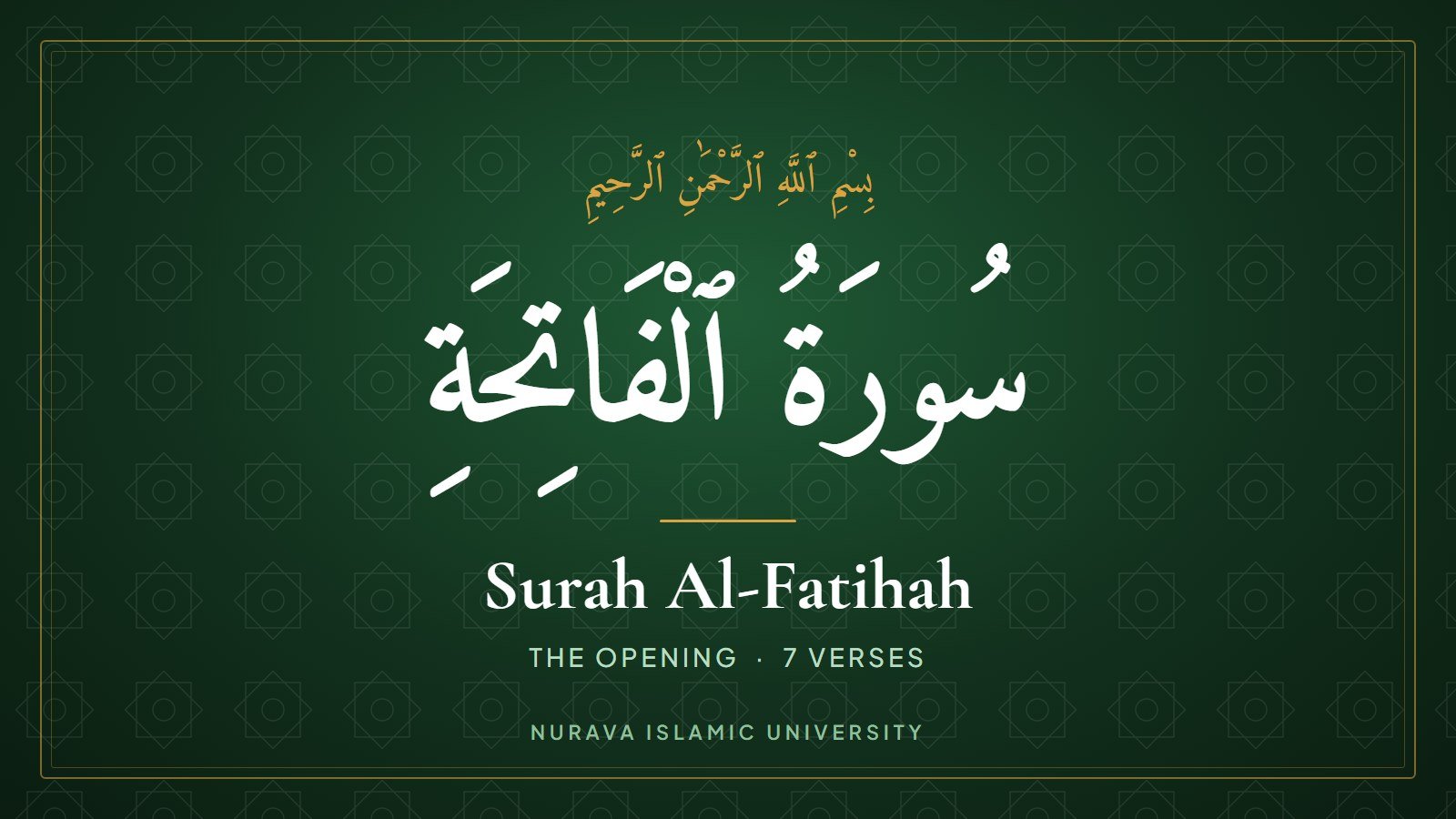
Surah Al-Fatihah ("The Opening") is the seven-verse first chapter of the Qur'an and the surah Muslims recite in every rak'ah of prayer. Its meaning is a conversation: it begins with praise of Allah, moves to worship and asking for help, and ends with one request, to be guided on the straight path. Read it line by line below, with transliteration, meaning and the Tajweed points that matter most.
If you pray, you already say these words many times a day. The goal of this guide is to help you say them knowing what they mean, and to say them correctly. You will find the Arabic, the transliteration, the meaning of each line, and a short Tajweed note for each verse that learners often get wrong.
Why Al-Fatihah Is Recited in Every Prayer
The Prophet ﷺ said: "Whoever does not recite Al-Fatiha in his prayer, his prayer is invalid" (Sahih al-Bukhari 756). In another narration he called it Umm al-Qur'an, "the Mother of the Qur'an", and a prayer without it is deficient (Sahih Muslim 395a).
That same narration in Sahih Muslim reports that Allah says: "I have divided the prayer into two halves between Me and My servant, and My servant will receive what he asks." It then describes how Allah answers each part as the servant recites it. This is why many teachers describe Al-Fatihah as a dialogue: the first part is praise of Allah, the last part is the servant's request.
Because Al-Fatihah is a required part of the prayer, learning to recite it properly is the first practical goal for almost every beginner. If you are starting from zero, our guide on how to start memorising the Qur'an shows a calm way to begin.
Surah Al-Fatihah Line by Line
You can also read and listen to the full surah on Surah Al-Fatihah on NurAva. The numbering below follows the standard Hafs mushaf, where the Basmalah is counted as verse 1.

Verse 1: The Basmalah
بِسْمِ ٱللَّهِ ٱلرَّحْمَٰنِ ٱلرَّحِيمِ
Bismillahir-Rahmanir-Rahim.
In the name of Allah, the Entirely Merciful, the Especially Merciful.
We begin every act by naming Allah and asking for His help. Two of His names appear here: Ar-Rahman (the Entirely Merciful) and Ar-Rahim (the Especially Merciful). Tajweed note: the Lam in "Allah" is light here because it follows the kasrah of "bi-smi", and the ending "Rahim" is a natural place to stop and breathe.
Verse 2: Praise belongs to Allah
ٱلْحَمْدُ لِلَّهِ رَبِّ ٱلْعَٰلَمِينَ
Alhamdu lillahi Rabbil-'alamin.
[All] praise is [due] to Allah, Lord of the worlds -
Alhamdu is more than "thank you": it is praise for who Allah is, in every situation. Rabb means the One who creates, owns, sustains and nurtures. "The worlds" includes everything that exists. Tajweed note: the letter Ha (ح) in "Alhamdu" comes from the middle of the throat and is softer and deeper than the Ha (ه) in "Allah". Learners often swap the two.
Verse 3: Ar-Rahman, Ar-Rahim
ٱلرَّحْمَٰنِ ٱلرَّحِيمِ
Ar-Rahmanir-Rahim.
The Entirely Merciful, the Especially Merciful,
The two names of mercy are repeated. Scholars explain the difference in slightly different ways, commonly that one speaks of mercy that covers all creation and the other of mercy especially for the believers. Tajweed note: the Lam of "Al" merges into the Ra (idgham shamsi), so you say "Ar-Rahman", not "Al-Rahman".
Verse 4: Master of the Day of Recompense
مَٰلِكِ يَوْمِ ٱلدِّينِ
Maaliki yawmid-din.
Sovereign of the Day of Recompense.
After mercy comes accountability. Everything will return to Allah, and He alone judges on that Day. A believer reads this with hope and with responsibility together. Tajweed note: in the Hafs recitation, "Maaliki" has a natural stretch of two counts on the Meem's alif. Other qira'at read this word differently, which is a topic for a teacher to explain.
Verse 5: You alone we worship
إِيَّاكَ نَعْبُدُ وَإِيَّاكَ نَسْتَعِينُ
Iyyaka na'budu wa iyyaka nasta'in.
It is You we worship and You we ask for help.
This is the centre of the surah, the part "between Me and My servant" in the hadith above. Worship and asking for help are placed together: we do the worship, and we need Allah's help even to do that. Tajweed note: the letter 'Ayn (ع) in "na'budu" and "nasta'in" is one of the hardest sounds for non-Arabic speakers. It is made deep in the throat and is not the same as a plain "a".
Verse 6: Guide us to the straight path
ٱهْدِنَا ٱلصِّرَٰطَ ٱلْمُسْتَقِيمَ
Ihdinas-siratal-mustaqim.
Guide us to the straight path -
The only request in the surah is for guidance, and it is made in the plural: "guide us". Even those who are already guided keep asking, because guidance is something we need every day. Tajweed note: the Sad (ص) in "as-sirat" is a heavy letter. Keep the back of the tongue raised so it does not sound like a plain "s".
Verse 7: The path of those You favoured
صِرَٰطَ ٱلَّذِينَ أَنْعَمْتَ عَلَيْهِمْ غَيْرِ ٱلْمَغْضُوبِ عَلَيْهِمْ وَلَا ٱلضَّآلِّينَ
Siratal-ladhina an'amta 'alayhim, ghayril-maghdubi 'alayhim wa lad-dallin.
The path of those upon whom You have bestowed favor, not of those who have evoked [Your] anger or of those who are astray.
The straight path is described by those who walk it: people Allah has favoured. We then ask to be kept away from two kinds of wrong turning. Tajweed note: the last word, "ad-dallin", carries a shaddah after a long vowel, so the madd is held for six counts. The Dad (ض) is a unique Arabic letter and usually needs a teacher's correction.
Common Mistakes When Reciting Al-Fatihah
Most errors are small, but because this surah is in every rak'ah, small errors get repeated thousands of times. These are among the ones teachers hear most often:
- Pronouncing ح (Ha) like ه, or ع ('Ayn) like a plain Alif.
- Saying ص (Sad) and ض (Dad) as a light "s" and "d".
- Pronouncing "Al-Rahman" instead of merging the Lam into the Ra.
- Shortening the long madd in "ad-dallin".
- Stopping in the middle of a verse to take a breath.
The practical fix is to recite to someone who can hear you and correct you, then repeat slowly. Our short guide to what Tajweed is and why it matters explains how these rules fit together, and our Tajweed course covers them step by step.
How to Learn Al-Fatihah Step by Step
Listen first
Listen to a reciter with clear Tajweed several times. Follow the Arabic text with your eyes, verse by verse.
Learn one verse at a time
Repeat a single verse until it flows, then join it to the previous one. Seven short verses make this realistic for most people over a few sittings, though the time varies from person to person.
Learn the meaning alongside
Read the meaning of each verse after you can say it. Understanding makes it easier to remember and easier to pray with presence.
Get corrected
Recite to a qualified teacher. Letters like ع, ح, ص and ض are hard to judge on your own.
Use it in prayer
Recite it in your daily prayers. Regular use fixes it in your memory better than any other method.
Children usually learn it more easily when the lessons are short, gentle and repeated, which is how our Qur'an classes for kids are taught.
Frequently Asked Questions
How many verses does Surah Al-Fatihah have?
Seven. In the Hafs mushaf used by most Muslims today, the Basmalah is counted as the first verse. Scholars have differed on whether the Basmalah is a verse of Al-Fatihah, and the total of seven is the same in the different counts.
Why is Al-Fatihah called Umm al-Kitab or Umm al-Qur'an?
The Prophet ﷺ referred to it as Umm al-Qur'an in the hadith recorded in Sahih Muslim 395a. Scholars commonly explain that the surah gathers the main themes of the Qur'an in brief: praise of Allah, worship, the Day of Judgement and guidance.
Do I have to recite Al-Fatihah in every rak'ah?
The hadith in Sahih al-Bukhari 756 says there is no prayer for the one who does not recite it. Scholars differ on details, such as whether a person praying behind an imam recites it too. Ask a qualified scholar about your own situation.
What does "Ihdinas-siratal-mustaqim" mean?
It means "Guide us to the straight path". It is the one request in Al-Fatihah, and Muslims repeat it in every prayer.
Can I learn Al-Fatihah without a teacher?
You can memorise the words from audio, but it is hard to hear your own mistakes with the difficult letters. A teacher who listens and corrects you is the most reliable way to recite it properly.
Want to recite Al-Fatihah with confidence?
Book a free demo class and a NurAva teacher will listen to your recitation, correct it gently, and suggest the right starting point for you or your child.
Keep Learning on NurAva
- Read and listen to Surah Al-Fatihah
- Learn Tajweed online
- Online Quran classes
- How to start memorising the Qur'an
- What is Tajweed and why it matters
- Meet our teachers
Sources
- Quran: Surah Al-Fatihah 1:1-7 (nurava.org/quran/surah-al-fatihah), Arabic and English checked against alquran.cloud (Uthmani, Sahih International)
- Sahih al-Bukhari 756: no prayer without Al-Fatihah
- Sahih Muslim 395a: Allah divides the prayer between Himself and His servant
This article is general guidance. Where scholars differ, ask a qualified scholar. Questions? Email [email protected] or visit nurava.org/contact.
Book a free demo class with a qualified NurAva teacher.